

Patrick Hughes, a senior mechanical engineering student in Klesse College of Engineering and Integrated Design, estimates he had 50 internship applications rejected before the summer of 2024.
It didn’t discourage him from taking his resume to NASA on a campus career day organized by the college.
“I dropped my resume with a NASA employee, and I had a good conversation, not expecting anything to come from it,” Hughes says. “I think it was about campus clubs and research, and it helped me stand out.”
Now he’s at the Johnson Space Center in Houston, working on parachutes to slow spacecraft on reentry.
“We’re taking the vehicle from freefall down to speeds where it’s not going to just explode on impact,” Hughes says
They will use an uncrewed reentry testing vehicle called HyperSTEP. It’s a low-cost, low-risk testing platform that can enter at low orbit and is easy to retrieve, collecting data the entire time.
“It allows you to test technologies before putting them on a $100 million spacecraft with people on board,” he says. “Many of these entry, descent and landing technologies may be used in future Artemis missions.”
Artemis is NASA’s mission to send astronauts to the moon. The next mission will send them on an orbit around the moon, farther than humans have ever traveled.
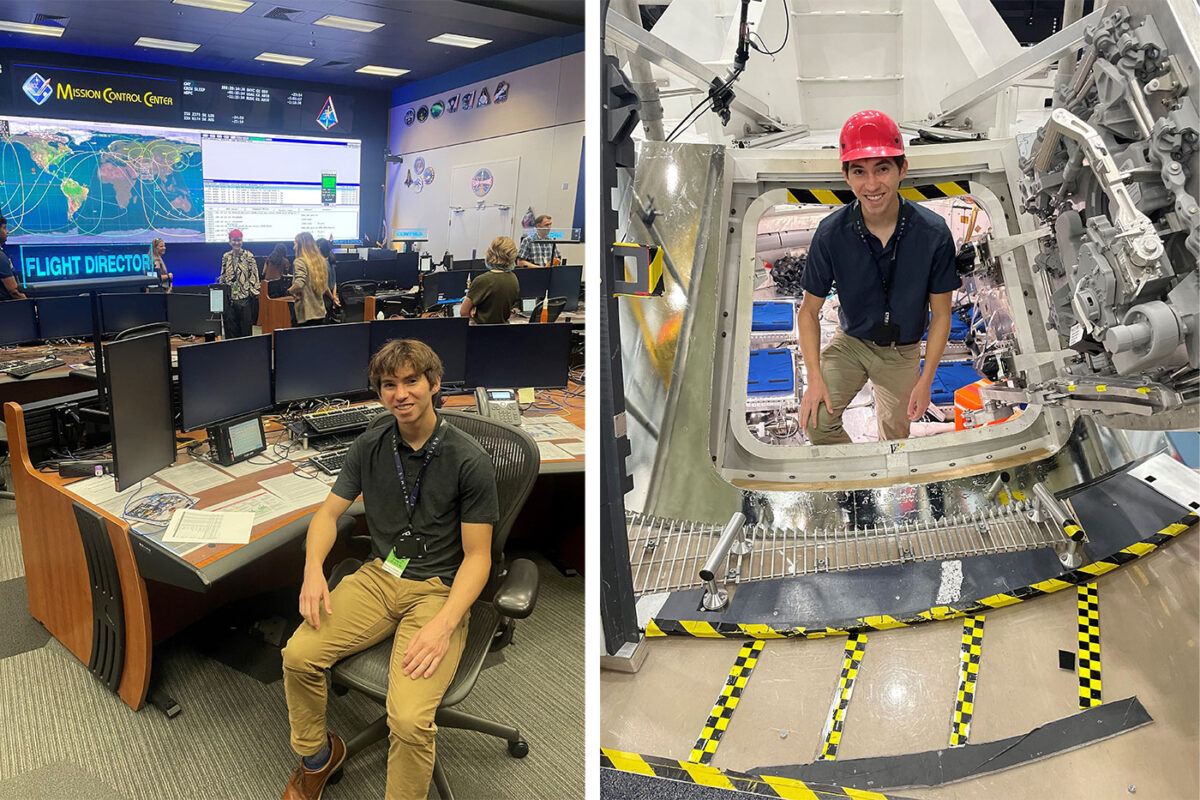
Hughes was randomly assigned to the team developing the parachutes. He had never worked on anything like it; however, he spent three years working in the UT San Antonio Hypersonics Lab with Chris Combs, PhD, associate dean of research, mechanical engineering and Dee Howard Memorial Endowed Faculty Fellowship in Mechanical Engineering.
“Working at NASA requires a very diverse skill set,” Hughes explained. “At UT San Antonio I did a lot of hands-on work, like machining. I conducted data analysis, high-speed flow exposure and microcontroller work.”
Last spring Hughes was able to take time out of the lab to spend a semester in Washington, D.C. as an Archer Fellow. The program provides accomplished students in the University of Texas System internships and classes focused on policy, history and advocacy. He interned on Capitol Hill while taking a public policy course.
“I realized in my time at NASA how critical federal policy is to the agency and the space industry,” Hughes says. “I was seeing very cool things and very broken things about the relationship between NASA and public policy.”
He says he had the opportunity to explore the relationship from the policy maker’s perspective and “it sounded fun.”
“I was mostly in the House of Representatives Committee on Science before returning to the lab in the fall,” he says.
After this semester, Hughes will be back in class in the fall to finish his undergraduate work.
Hughes says he’s not sure if he will pursue a post-graduate degree or continue with NASA, admitting he had a misplaced idea about the agency.
“There’s all this hype around the agency that you think about the people who work here like they’re wizards, or something,” he says. “But they’re people. They’re really smart, and I get to work with them.”
Hughes encourages others to remain persistent and not forget to apply to aerospace contractors.
“Anyone who sets their mind to it can do it,” he says. “It’s just work. It’s not out of reach.”


No comment yet, add your voice below!